
When Should You File a Declaratory Suit and When Is an Injunction Suit Sufficient?
Introduction
Property disputes constitute a significant portion of civil litigation in India. In many cases, individuals approach a Civil Court seeking protection of their property rights without clearly understanding the nature of the legal remedy available to them.
One of the most common mistakes made by litigants is filing a Suit for Permanent Injunction when the dispute actually requires a Suit for Declaration of Title, or vice versa. Choosing the wrong relief can result in dismissal of the suit, unnecessary litigation, additional costs, and years of avoidable delay.
The distinction between a Declaratory Suit and an Injunction Suit is therefore not merely procedural; it is a substantive legal issue that determines whether the Court can effectively adjudicate the dispute.
This article explains the legal principles governing both remedies, the circumstances in which each remedy is appropriate, and the principles laid down by the Supreme Court of India.
The primary statutory provisions governing these remedies are contained in the Specific Relief Act, 1963.
Section 34 – Declaratory Decree
Section 34 empowers a Civil Court to declare the legal character or legal right of a person when such right is denied or threatened by another person.
The provision enables the Court to officially recognize and declare the plaintiff’s legal status or ownership over the property.
Legal Framework
A declaratory decree does not merely protect possession; it conclusively determines legal rights between the parties.
Sections 36 to 42 – Injunctions
The law relating to injunctions is contained in Sections 36 to 42 of the Specific Relief Act.
These provisions authorize Courts to grant:
i). Temporary Injunctions
ii). Perpetual (Permanent) Injunctions
iii). Mandatory Injunctions
Among these, Permanent Injunctions are commonly sought in property disputes to prevent unlawful interference with possession.
What Is a Declaratory Suit?
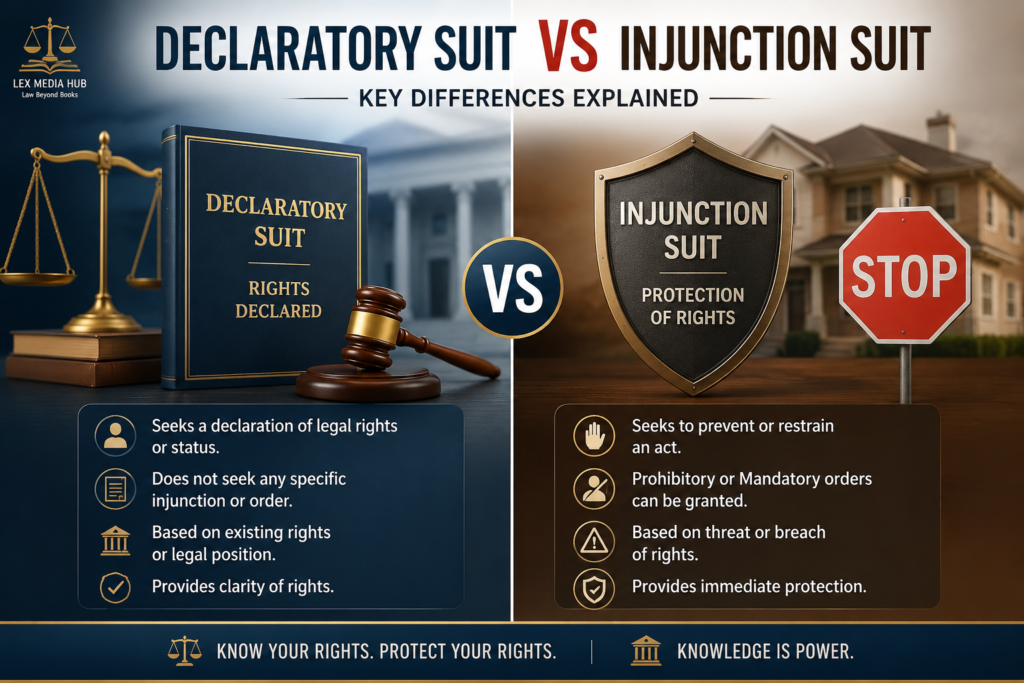
A Declaratory Suit is instituted when the plaintiff seeks a judicial declaration regarding ownership, title, legal status, or any other legal right.
In simple terms, the plaintiff requests the Court to officially declare:
“I am the lawful owner of this property.”
The declaration becomes necessary when another person disputes the plaintiff’s title or asserts a competing claim.
Purpose of a Declaratory Suit
The principal objective is to remove uncertainty regarding ownership. Typical situations include:
i). Rival claims over ownership
ii). Conflicting title documents
iii). Fraudulent Sale Deeds
iv). Forged Settlement Deeds
v). Invalid Gift Deeds
vi). Competing Wills
vii). Disputed inheritance
viii). Boundary disputes involving title
ix). Government records contradicting ownership documents.
In all these situations, the real controversy concerns title, not merely possession.
Relief Granted:
A Civil Court may declare that:
i). The plaintiff is the lawful owner.
ii). The defendant has no legal right over the property.
iii). A disputed document is invalid.
iv). The plaintiff possesses valid legal title.
Such declaration removes the legal uncertainty surrounding the property.
What Is an Injunction Suit?
An Injunction Suit is intended to prevent a person from committing an unlawful act.
In property matters, the plaintiff usually requests the Court to restrain the defendant from interfering with peaceful possession.
Unlike a Declaratory Suit, an Injunction Suit does not determine ownership unless determination of title becomes unavoidable.
Its primary purpose is preservation rather than declaration of rights.
Common Types of Injunctions :
1. Temporary Injunction :
Granted during the pendency of the suit to preserve the existing state of affairs until final adjudication.
2. Permanent Injunction :
Granted after final disposal of the suit, permanently restraining the defendant from interfering with the plaintiff’s lawful possession.
3. Mandatory Injunction:
Issued to compel a person to perform a legal obligation, such as:
i). Removing an illegal construction
ii). Demolishing an encroachment
iii). Restoring possession where legally permissible
iv). Removing unauthorized structures
Declaratory Suit vs. Injunction Suit:
The distinction becomes easier when the following principle is understood:
i). A Declaratory Suit protects legal ownership.
ii). An Injunction Suit protects lawful possession.
Ownership and possession frequently coexist, but they are not identical legal concepts.
A person may possess property without having perfect legal title. Conversely, the true owner may temporarily lose possession but continue to retain ownership. The remedy depends upon the nature of the dispute before the Court.
The Concept of “Cloud on Title” :
One of the most important principles in property litigation is the concept known as a Cloud on Title.
A cloud on title exists when another person raises a genuine dispute regarding ownership.
Examples include:
i). Production of another registered Sale Deed
ii). Claim based upon inheritance
iii). Competing Gift Deed
iv). Rival Partition Deed
V). Disputed Will
vi). Government acquisition claim
vii). Revenue entries creating conflicting ownership claims
Once such a substantial dispute arises, mere protection of possession is generally insufficient. The Court must first determine who legally owns the property. Only thereafter can consequential reliefs such as injunction be appropriately granted.
Landmark Supreme Court Judgment :
Anathula Sudhakar v. P. Buchi Reddy (Dead) by LRs & Others (2008)
One of the leading authorities on this subject is the decision of the Supreme Court in Anathula Sudhakar v. P. Buchi Reddy (Dead) by LRs & Others.
The Court clarified the distinction between suits for declaration and suits for injunction and laid down practical guidelines for determining the appropriate remedy.
The Supreme Court broadly explained the legal position as follows:
Situation 1
If the plaintiff is in lawful possession and no genuine dispute exists regarding title, a Suit for Permanent Injunction is ordinarily sufficient.
Situation 2
If the plaintiff’s title is seriously disputed or a cloud is cast upon ownership, the plaintiff should ordinarily seek a Declaration of Title, along with consequential relief such as injunction wherever necessary.
Situation 3
Where the plaintiff is not in possession and seeks recovery of possession, the appropriate remedy generally includes:
i). Declaration of title (where required)
ii). Recovery of possession
iii). Consequential injunction
The Court emphasized that selecting the proper remedy depends upon the factual circumstances of each case and not merely upon the wording of the plaint.
Practical Illustration :
Example 1
Mr. A is the registered owner of agricultural land. His neighbour attempts to trespass without asserting ownership. Here, the dispute concerns interference with possession rather than ownership. A Suit for Permanent Injunction may be sufficient.
Example 2
Mr. A possesses a registered Sale Deed. Mr. B also produces another registered Sale Deed claiming ownership over the same property. The dispute now concerns legal title. Mr. A should ordinarily seek a Declaration of Title along with appropriate consequential relief.
When Should You Seek Declaration? When Is an Injunction Alone Sufficient?
When Does a Declaratory Suit Become Necessary?
A Declaratory Suit becomes necessary when the plaintiff’s ownership or legal right over the property is under a genuine challenge. Merely being in possession of the property does not always eliminate the need for a declaration. The Court must first determine who has the lawful title before granting consequential reliefs.
In practical terms, a declaration is generally required when:
i). A rival claimant asserts ownership over the property.
ii). Two or more registered Sale Deeds exist concerning the same property.
A forged or fraudulent document affects the plaintiff’s title.
iii). A Will, Gift Deed, Settlement Deed, or Partition Deed is disputed.
iv). Government or revenue records create a substantial dispute regarding ownership.
v). The defendant specifically denies the plaintiff’s title in the written statement.
In such circumstances, the dispute is not merely about possession; it is fundamentally about ownership.
What Is Meant by “Cloud on Title”?
A “cloud on title” arises when another person’s claim creates genuine uncertainty regarding the plaintiff’s ownership. The challenge must be substantial and bona fide. A mere unsupported allegation does not automatically amount to a cloud on title.
Examples include:
i). A registered Sale Deed executed in favour of another person.
ii). A competing claim based on inheritance.
iii). A rival Partition Deed.
iv). A disputed Gift or Settlement Deed.
v). A claim under a Will.
vi). Government acquisition or ownership claims.
When such a cloud exists, the Court ordinarily expects the plaintiff to seek a declaration of title before or along with an injunction.
When Is an Injunction Suit Alone Maintainable?
There are many situations where filing only a Suit for Permanent Injunction is legally appropriate. Generally, an injunction alone may be sufficient where:
i). The plaintiff is in peaceful and lawful possession.
ii). The defendant is merely attempting to interfere with possession.
iii). There is no genuine dispute regarding ownership.
iv). The defendant does not claim a better title.
v). The controversy relates only to protection of possession.
The Court, in such cases, is primarily concerned with preventing unlawful interference rather than deciding ownership.
Possession vs. Ownership :
One of the most misunderstood concepts in property law is the distinction between possession and ownership.
Possession:
Possession means actual physical control over the property. A person may possess property:
i). As an owner.
ii). As a tenant.
iii). As a lessee.
iv). As a mortgagee.
v). As a licensee.
vi). Under any other lawful arrangement.
vii). Possession alone does not necessarily establish ownership.
Ownership (Title) :
Ownership refers to the legal right recognized by law to enjoy, transfer, mortgage, gift, or otherwise deal with the property. Ownership is ordinarily established through legally recognized evidence such as:
i). Registered Sale Deeds.
ii). Registered Gift Deeds.
iii). Registered Settlement Deeds.
iv). Partition Deeds.
v). Probate or Letters of Administration where applicable.
vi). Succession through operation of law.
Other valid title documents.
The Court examines the entire chain of title before determining ownership.
Is Patta Proof of Title?
A common misconception among property owners is that a Patta conclusively proves ownership. This is legally incorrect. A Patta is primarily a revenue record maintained for fiscal and administrative purposes. Although it may support possession and serve as a relevant piece of evidence, it is not a title deed.
Indian Courts have consistently held that title is determined based on legally recognized title documents and applicable legal principles, not merely on revenue entries.
Therefore:
i). A Patta can strengthen a case.
ii). A Patta alone does not establish ownership.
iii). Revenue records cannot override valid title documents.
Can an Injunction Suit Decide Title?
Generally, no.
An Injunction Suit is not intended to determine complicated questions of ownership. However, in limited situations where deciding a minor issue relating to title becomes necessary for deciding possession, the Court may incidentally examine aspects of title. Such incidental findings do not substitute for a formal declaration of title in cases involving serious ownership disputes. Therefore, where title itself is substantially in issue, a Declaratory Suit remains the appropriate remedy.
Consequential Relief :
The law recognizes that a declaration alone may not provide complete justice. Accordingly, a plaintiff often combines a declaration with consequential reliefs.
For example:
i). Declaration of title.
ii). Permanent Injunction.
iii). Recovery of possession.
iv). Cancellation of fraudulent documents (where legally maintainable).
v). Mesne profits, where applicable.
The exact relief depends upon the facts of each case.
Practical Illustrations:
Illustration 1 – Mere Interference
Mr. A owns a residential property and is peacefully residing there. Mr. B frequently threatens to enter the property but never claims ownership. Since there is no dispute regarding title, Mr. A may seek a Permanent Injunction to restrain unlawful interference.
Illustration 2 – Rival Sale Deeds
Mr. A purchases land through a registered Sale Deed. Later, Mr. B produces another registered Sale Deed relating to the same property and claims ownership.
The dispute now centers around title.
Mr. A should ordinarily seek a Declaration of Title along with consequential relief.
Illustration 3 – Forged Gift Deed:
A property owner discovers that another person relies upon a forged registered Gift Deed to claim ownership. Since the forged document casts a cloud upon the plaintiff’s title, a Declaratory Suit, along with appropriate consequential relief, may be necessary.
Illustration 4 – Family Property Dispute
Two siblings inherit ancestral property. One sibling exclusively claims ownership based upon an alleged Will, while the other disputes its validity. As ownership itself is disputed, the Court must determine title before granting consequential relief.
Practical Guidance Before Filing a Suit:
Before instituting a property suit, every litigant should carefully evaluate:
1. Is there a genuine dispute regarding ownership?
2. Am I presently in lawful possession?
3. Does the defendant claim ownership?
4. Is there any registered document affecting my title?
5. Do I require only protection of possession, or a judicial declaration of ownership?
Answering these questions helps determine the correct legal remedy.
Important Legal Principle:
A Civil Court grants relief based on the nature of the dispute—not merely on the relief claimed in the plaint. A plaintiff cannot avoid seeking a declaration where the facts clearly disclose a substantial title dispute. Likewise, a declaration should not be sought unnecessarily where the controversy relates only to interference with possession.
The appropriate remedy must always correspond with the actual cause of action and the factual matrix of the case.
Declaratory Suit vs. Injunction Suit: Understanding the Difference in Property Disputes Under Indian Law
Common Mistakes Made by Litigants
One of the principal reasons for prolonged property litigation is the failure to seek the appropriate legal remedy at the outset. Filing the wrong type of suit may not only delay justice but may also result in dismissal of the case or the necessity of instituting fresh proceedings.
The following are some of the most common mistakes observed in civil property disputes:
1. Filing Only an Injunction Suit Despite a Serious Title Dispute
This is perhaps the most frequent mistake in property litigation. Where ownership is genuinely disputed and the defendant asserts an independent title, seeking only a Permanent Injunction may be insufficient.
The Court may require the plaintiff to first establish legal ownership through a Declaratory Suit before considering consequential relief.
2. Assuming That Possession Alone Guarantees Success
While possession is an important factor in property disputes, it is not always decisive. A person may be in possession without having lawful title. Where ownership itself is disputed, possession alone may not entitle the plaintiff to the relief sought.
3. Treating Revenue Records as Conclusive Proof of Ownership
Many litigants mistakenly believe that documents such as:
i).Patta
ii).Chitta
iii).Adangal
iv).Revenue extracts
v).automatically establish ownership.
These documents are relevant pieces of evidence but are not documents of title. The Court primarily determines ownership based upon legally recognized title documents and the applicable principles of law.
4. Ignoring Fraudulent Documents
Where forged or fraudulent Sale Deeds, Gift Deeds, Settlement Deeds or other documents affect the plaintiff’s title, merely seeking an injunction may not adequately resolve the dispute.
Appropriate declaratory or other consequential relief may become necessary depending upon the facts of the case.
5. Delaying Legal Action
Property disputes often become increasingly complicated with the passage of time.
Delays may result in:
i). Multiplicity of proceedings.
ii). Additional rival claims.
iii). Further alienation of property.
iv). Evidentiary difficulties.
v). Increased litigation costs.
Prompt legal action is therefore advisable whenever property rights are threatened.
Practical Takeaways
Before deciding which civil remedy to pursue, every litigant should carefully consider the following questions:
i). Is my ownership being disputed?
If yes, a Declaratory Suit may be necessary.
ii). Am I merely trying to prevent unlawful interference with my possession?
If yes, a Permanent Injunction may be sufficient, provided there is no substantial dispute regarding title.
iii). Is there any registered document challenging my ownership?
If yes, the Court may first need to determine title before granting consequential relief.
iv). Do I require additional relief?
Depending upon the facts, the plaintiff may also require:
Recovery of possession.
i).Cancellation of documents (where legally maintainable).
ii).Permanent Injunction.
iii).Mandatory Injunction.
iv).Mesne profits or other consequential reliefs.
The appropriate relief should always be determined after considering the complete factual and legal circumstances.
Frequently Asked Questions (FAQs)
1. Can I obtain a Permanent Injunction without seeking a Declaration?
Yes.
Where there is no genuine dispute regarding title and the plaintiff is in lawful possession, a Suit for Permanent Injunction may be maintainable. However, each case depends upon its own facts.
2. Does every property dispute require a Declaratory Suit?
No.
A declaration is generally required only where ownership or legal rights are seriously disputed or where a cloud exists over the plaintiff’s title.
3. Does a Patta conclusively establish ownership?
No.
A Patta is a revenue record. While it may support possession and other factual circumstances, it is not conclusive proof of legal title.
4. Can the Civil Court decide ownership?
Yes.
Questions relating to ownership, legal title, and declaration of rights fall within the jurisdiction of the competent Civil Court.
5. Does an Injunction Decree establish ownership?
No.
An Injunction Decree merely protects possession or restrains unlawful acts. It does not ordinarily amount to a judicial declaration of ownership.
6. Can both Declaration and Injunction be sought in the same suit?
Yes.
Where the facts justify it, a plaintiff may seek a Declaration of Title together with consequential relief such as Permanent Injunction, Recovery of Possession, or other appropriate remedies.
Advocate’s Practical Note
Every property dispute should begin with one fundamental question:
“What is the real dispute before the Court?”
). If the controversy concerns ownership, the litigation should ordinarily focus upon establishing title.
ii). If the controversy concerns only interference with lawful possession, an injunction may be the appropriate remedy.
iii). Attempting to simplify a complex title dispute by filing only an Injunction Suit may unnecessarily prolong litigation and increase costs.
iv). Careful evaluation of the pleadings, title documents, possession, and the defendant’s claim is therefore essential before instituting any civil suit.
Conclusion
The distinction between a Declaratory Suit and an Injunction Suit is one of the most fundamental principles of Indian property law. Although both remedies are intended to protect legal rights, they serve different purposes. A Declaratory Suit is intended to remove uncertainty regarding ownership or legal status by obtaining a judicial declaration of rights.
An Injunction Suit is intended to prevent unlawful interference with possession or other legal rights. The choice between these remedies depends not upon the plaintiff’s preference but upon the true nature of the dispute.
Where ownership is seriously disputed and a cloud exists over the plaintiff’s title, a declaration may become indispensable.Conversely, where the plaintiff is in peaceful possession and title is undisputed, a Permanent Injunction may adequately protect the plaintiff’s rights.
Every property dispute must therefore be assessed on its own facts, applicable law, documentary evidence, and judicial precedents before determining the appropriate remedy.
Seeking the correct relief at the outset is often the key to effective civil litigation and the timely protection of legal rights.
Key Judicial Principles:
i). A Declaratory Suit determines legal rights and ownership.
ii). An Injunction Suit protects lawful possession and prevents unlawful interference.
iii). A cloud on title generally necessitates a declaration of ownership.
iv). Revenue records are evidentiary documents but do not, by themselves, establish title.
v). The nature of the dispute—not merely the wording of the plaint—determines the appropriate remedy.
vi). Proper drafting and selection of relief are essential for successful civil litigation.
Disclaimer:
This article is intended solely for legal awareness and educational purposes. It does not constitute legal advice or create an advocate–client relationship. Property disputes are highly fact-specific, and the appropriate legal remedy depends upon the particular facts, documentary evidence, and applicable law. Readers are advised to consult a qualified legal practitioner before initiating or defending any legal proceedings.
© Lex Media Hub | All Rights Reserved
Unauthorized reproduction, republication, or commercial use of this article, in whole or in part, without prior written permission from Lex Media Hub is prohibited.